
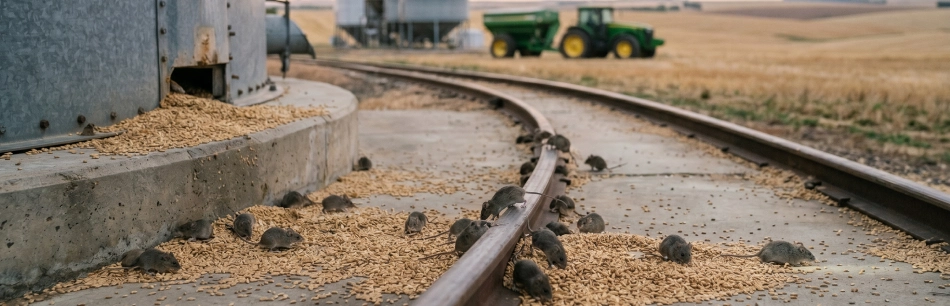
Western Australia’s grainbelt is in serious trouble. Mouse numbers have exploded to levels that rival the devastating 2021 plague that cost Australian agriculture an estimated $1 billion, and in some paddocks they are actually worse. With seeding season already underway, the timing could not be more damaging.
Here is what grain growers need to know about what is happening, why it happened, and what you can do about it right now.
Some WA paddocks are recording more than 4,000 mice per hectare. For context, normal summer populations sit at around 5 to 10 animals per hectare. Economic damage starts at around 200 per hectare. A plague is officially declared at 800 to 1,000. At 4,000 per hectare, you are not dealing with a pest problem, you are dealing with an infestation on a scale that overwhelms standard control measures.
In March, the GRDC formally warned WA growers to act before seeding, reporting burrow counts north of Geraldton as high as 40 per 100 square metres. To put that in perspective, two or three burrows per 100 square metres would normally raise concern. CSIRO research officer Steve Henry, who has studied reported mouse numbers in paddocks from Geraldton to Esperance, described the figures as alarming.
The worst zones run from Geraldton through the central Wheatbelt around Merredin and down toward Esperance, with CSIRO monitoring also flagging the Kwinana West region. The plague is not uniform across the state, but where it has taken hold, the pressure is severe. South Australia is under significant pressure too, particularly on the Adelaide Plains and Yorke Peninsula, with mouse numbers at their highest in at least four years.
One Mid West grower, farming 11,000 hectares of crop including lupins, canola, wheat, and barley, told Farm Weekly he was counting around 150 holes per 100 square metres in the worst areas of his property. His assessment: numbers are at least double what he saw during the 2021-22 plague. He added that some areas of his cropping programme will need reseeding because the mice got there first.
Mouse plagues tend to follow big seasons. Good rainfall drives bumper crops, and the leftover grain scattered across paddocks after harvest gives mouse populations exactly what they need to breed rapidly. But the story behind the 2026 outbreak is a little more specific than that.
The spark came from an unusual source. Farmers general manager Cameron Beeck said his organisation had forecast the surge late last year, after ex-Tropical Cyclone Mitchell brought hailstorms that knocked grain to the ground across parts of WA. That initial food source was then compounded by further summer rain events, including ex-Tropical Cyclone Narelle. By the time seeding rolled around in autumn, the mouse population was already well ahead of where farmers needed it to be, and growing fast.
There is also a longer-term structural factor at play. Modern conservation cropping practices have changed the paddock environment in ways that benefit mice. No-till farming and stubble retention are excellent for soil health, reducing erosion, retaining moisture, and sequestering carbon. But leaving stubble on the ground also gives mice permanent shelter and year-round cover that they would not have had under traditional tillage. Researchers say plague cycles are becoming more persistent partly as a result. As Andrew Weidemann, southern region director at Grain Producers Australia, put it: farmers have created a fantastic habitat to grow crops, but they have also increased the number of rodents living in those paddocks.
The biology does the rest. A female mouse can start breeding at just six weeks old and produce up to ten pups every twenty days. Under plague conditions, with abundant food and good shelter, those numbers compound with startling speed. A modest background population does not stay modest for long, and by the time most growers recognise the scale of the problem, it is already well beyond easy control.
Mice are very good at finding freshly sown grain. Growers can start seeding, notice a few mice around, and think little of it, only to return days later to find that the grain has been consumed before it had a chance to germinate. The mice have learned, through repeated exposure, exactly where to find the seed. They follow the furrows.
For many growers this season, that means reseeding entire sections of paddock at significant extra cost, on top of fuel and fertiliser bills that are already elevated. WA Liberal senator Slade Brockman described newly sown crops as at immediate risk of severe damage or complete loss, warning that every day without access to more effective control tools compounds the economic impact across regional economies.
The financial stakes are substantial. The 2021 plague cost Australian agriculture an estimated $1 billion over an 11-month period. Growers who lived through that season know what a full-scale plague looks like on the bottom line: the cost of baiting, the cost of reseeding, the machinery damage, and at the end of it all, often only an average crop to show for it. Many are looking at the same trajectory now, without the benefit of a stronger registered bait to help them get ahead of it.
This is where grower frustration is running highest, and with good reason.
The only bait currently approved for broadacre mouse control in Australia is zinc phosphide at 25 grams per kilogram, known as ZP25. The problem is that CSIRO researcher Dr Steve Henry has built a substantial body of internationally published, peer-reviewed evidence showing that ZP25 is simply not effective enough when food pressure is high. During a plague, mice have so much background feed available that they often do not consume enough bait to receive a lethal dose. Worse, they can become bait shy as a result, making subsequent applications even less effective.
A double-strength version, ZP50, was approved on an emergency basis during the 2020-21 plague and proved significantly more effective. The logic is straightforward: when food is abundant, mice need to consume less bait to achieve a lethal dose, which is exactly what ZP50 provides. That emergency permit was not renewed when it expired, and there is currently virtually no legal access to ZP50 in Australia.
On 28 April 2026, the APVMA rejected a new emergency permit application for ZP50, stating that the current research does not meet its regulatory standards. The decision has left growers, agronomists, and researchers deeply frustrated. The CSIRO body of work is globally recognised, and the same evidence was previously accepted by the APVMA in its earlier decision-making. Senator Brockman wrote to the authority stating it was not credible to dismiss research that is widely regarded as globally leading and was previously used to justify approval.
The APVMA has acknowledged that new applications are being assessed as a matter of high priority, and that timely access to effective control is critical in outbreak conditions. But as GPA’s Weidemann cautioned, growers should not expect access to ZP50 in the short term. The push now is to build the strongest possible evidence base for a future emergency permit, with a longer-term goal of achieving permanent registration of ZP50.
Grain Producers Australia, WAFarmers, and the WA Grains Group are all actively working on this. The practical ask for growers right now: document your ZP25 results carefully. Record what you are seeing in the paddock, what food sources are present, and whether baiting is actually achieving control. That on-the-ground evidence is exactly what the permit application needs.
The financial damage gets the headlines, but the personal impact of a mouse plague is something else entirely, and anyone who has been through one will tell you it is hard to convey to someone who has not.
Unlike drought, there is no escaping a mouse plague. They get into the pantry, chew through food containers and plastic packaging, damage wiring in tractors and vehicles, and run across beds at night. Rural communities during plague events report significant levels of anxiety and psychological stress. Some residents face exposure to rodent-borne disease. The cumulative effect on mental health in affected communities is well documented from the 2021 experience, and those same pressures are returning now.
All of this is landing on growers who are already stretched by elevated input costs, ongoing fertiliser supply uncertainty, and in some areas, the aftermath of a difficult weather season. CSIRO’s Steve Henry summed it up to 9News: this is another kick in the guts, not just for farmers but for the whole community, from small businesses to supermarkets to anyone who relies on a functioning regional economy.
The window to act before populations become truly unmanageable is narrow. Here is where to focus your efforts immediately.
Get into the paddocks on foot. Assessing mouse activity from the cab of a ute will consistently underestimate the problem. Walk the paddocks properly and use chew cards to get an accurate baseline before and after any baiting. The cards do not lie.
Bait before seeding wherever possible. Pre-sowing baiting is significantly more effective than trying to protect an established crop after the fact. If seeding is already underway, bait directly behind the seeder to give the crop its best chance of establishment.
Record your ZP25 results in detail. Note your burrow counts, chew card readings before and after baiting, what food sources are present in the paddock, and honestly assess whether your baiting is achieving real control. This data is being actively sought by Grain Producers Australia and WAFarmers to build the case for ZP50 access.
Protect your stored grain. Mouse-proof storage and sealing gaps in sheds and silos should be an immediate priority. Once mice gain access to stored grain, losses escalate quickly and contamination can render grain unmarketable. Experts specifically recommend investing in proper mouse-proof storage rather than relying on ad hoc solutions.
Consider targeted exclusion fencing. Not practical across an entire property at scale, but targeted mouse-proof fencing around seed storage, machinery sheds, or particularly high-value paddock areas has proven effective for some growers and is worth considering alongside chemical control.
Stay in contact with your agronomist. The situation is evolving week by week. Local advice on timing, bait placement, and product use will be critical as the season progresses.
The plague is spreading. WA’s Wheatbelt is already deep in it, and mouse activity is rising in South Australia. Eastern states, including NSW, Victoria, and Queensland, are sitting at relatively low levels for now, though isolated hotspots exist in parts of the Darling Downs and Wimmera regions and the situation bears watching.
The deeper concern is structural. Without access to more effective baiting tools, and with no-till farming continuing to expand the available habitat for mice across the grainbelt, recovery from this peak may be slower than in previous cycles. The conditions that produce plagues, good seasons followed by abundant residual grain, are not going away. And the habitat improvements that modern farming has inadvertently provided for mice are not going away either.
Researchers have noted that natural predators, including owls, raptors, and snakes, do benefit from the temporary abundance of prey during a plague, but the aftermath can be harsh for those populations too. When mouse numbers crash, predator populations that expanded in response can face sudden food shortages. Rodent poisons used during control efforts can also move through the food chain. These are not reasons to avoid baiting, but they are reasons to apply it carefully and in accordance with label directions.
Populations in WA’s grainbelt are at or beyond 2021 levels in the worst-affected areas, seeding is underway, and the stronger bait that researchers recommend is not currently available. That is a genuinely difficult combination, and growers are right to be concerned.
Act early. Monitor closely. Record everything. Connect with your local agronomist and stay across communications from WAFarmers and the GRDC. The ZP50 permit situation remains the most critical regulatory decision facing WA grain growers this season, and progress on that front depends in large part on the quality of evidence that growers themselves can provide.
This plague is not inevitable in its worst-case outcome. Early action, good monitoring, and community-level coordination have made a difference in past events. They can again.
Search our marketplace