
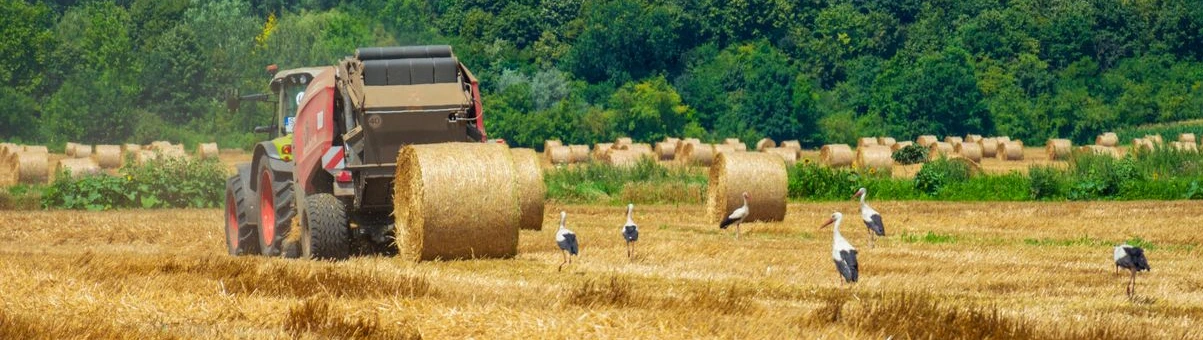
A baler is one of the biggest purchases you will make for a hay operation, and it is one people get wrong more often than they would care to admit. The machine itself is only half the decision. The other half is what you are actually baling, who is buying it, and how you plan to shift it once it is off the ground. Sort those three out before you start looking at machines and the right baler more or less picks itself.
So before we get into makes and models, be honest about your operation. Are you feeding your own cattle, or selling hay? By the bale to horse owners, or by the truckload to a contractor? Do you have a loader, or a strong back and a trailer? The answers point you straight at one of the three bale types, and everything else follows from there.
Almost every baler you will look at makes one of three things: round bales, small square bales, or large square bales. They are not better or worse than each other. They just suit different jobs.
Round balers are the workhorse of most Australian cattle and mixed farms. One person, a tractor and a front-end loader can bale, cart and feed out without ever getting off the seat, and a round bale sheds water reasonably well if you get caught storing it outside. If you are feeding your own stock or selling into the cattle market, this is usually where you land.
There are two flavours worth knowing. A fixed chamber baler forms the bale in a chamber that stays the same size, which makes for a softer core and a simpler, cheaper machine. It does a fine job on dry hay. A variable chamber baler uses belts that expand as the bale grows, so you get a denser, more consistent bale and can change bale size on the go. The density is the key point. If there is any chance you will make silage, or you want tight bales that travel and store well, the variable chamber is worth the extra spend. For straight dry hay on a smaller place, a fixed chamber will not let you down.
Small square bales are the ones you can still pick up by hand, roughly twenty to forty kilos apiece. If you are selling to horse owners, running a smaller place, or moving hay in lots that a bloke can stack in a shed without a loader, this is your bale. There is a reason the horse market still pays well for a good small square.
The catch is handling. Making the bales is the easy part. Picking up hundreds of them off the paddock in the heat is the part that ages you. Plenty of people pair a small square baler with a bale accumulator or a system like a Bale Baron that groups them into bundles, which turns a back-breaking job into a one-person one. Factor that in, because the labour is the real cost with small squares, not the baler.
Large square bales are about volume and stacking. They fit on a truck like bricks in a wall, which is exactly why export operations and contractors lean on them. High density, high output, and far less mucking about per tonne once you are moving serious quantities.
They are not a starter machine. You need a decent tractor to pull one, a telehandler or loader to shift the bales, and the volume to justify the outlay. But if you are baling hundreds of hectares or selling into markets that want dense, uniform, transport-friendly bales, nothing else comes close on throughput.
If silage is your game, look at a combination baler-wrapper that bales and wraps in the one pass. It is a bigger investment, but for anyone making a lot of baled silage it earns its place in speed and in getting the wrap on fast, which is half the battle with good silage. Our guides onmaking silage andchoosing silage wrap go into the detail there.
This is the bit that catches people out. A baler is only as good as the tractor running it, and an underpowered tractor will make hard work of a big baler, or simply will not run it at all.
As a rough guide, a small square baler will run behind a modest tractor of forty to sixty horsepower. Round balers ask for more, somewhere from sixty upward depending on the size and whether it is a variable chamber, which takes more grunt to build those dense bales. Large square balers are in another bracket again and want a genuinely big tractor behind them. Check the PTO horsepower the baler is rated for, make sure your tractor has the hydraulics and electrics for the tailgate and any wrap system, and match the PTO speed. If you are buying the baler and the tractor together, size them as a pair rather than buying one and hoping the other copes.
On a round baler you will choose between net wrap and twine, and most people end up running net for good reasons. Net wraps the bale in a couple of turns instead of twenty, so you spend less time stationary and get through more bales an hour. It holds the bale’s shape better, sheds water better if the bale lives outside, and knocks off less leaf in the process. Twine is cheaper per bale and worth keeping on hand as a backup, but for pace and weather, net earns its keep. You will findnet wrap and twine alongside the other consumables.
Balers hold up well, and the second-hand market is full of good machines, so do not feel you have to buy new. Match the machine to how much you will actually use it. If you are baling a few weeks a year, a sound used baler is often the smarter money. If you are a contractor running it flat out through the season, new or near-new with a warranty starts to make sense.
If you are buying used, a baler tells you plenty if you know where to look. Work through this before you commit:
Pairing this with a proper tractor inspection is smart if you are buying both. Ourused tractor checklist runs through that side of it.
You will see the usual names across the Australian market, John Deere, New Holland, Case IH, Massey Ferguson, Krone, Claas, Kuhn, Vermeer, and McHale, which has a strong following for round balers and baler-wrappers on the silage side. They all make good gear. Rather than chasing a badge, buy the machine that suits your bale type and your budget, from a seller who can tell you its history and let you see it work. A well-kept baler of an ordinary brand beats a neglected one of a fancy brand every time.
Pricing moves around a fair bit with condition, age and the market, so treat this as a rough shape rather than a quote. Small square balers are the most affordable way in. Round balers sit in the middle, with variable chamber machines dearer than fixed. Large square balers and baler-wrappers are the serious end of the spend. The honest answer on price is to look at what is actually selling, so browse currentbaler listings to get a real feel for the money in your bale type.
You can browsebalers for sale from sellers around the country on LocalAg, along with thetractors to run them and thenet wrap, twine and consumables to keep them going. Every sale is protected through CheckVault escrow, so your money is held securely until the machine is in your yard and matches what was described. And when the bales are in the shed, you can list them for sale in thehay and fodder market to buyers looking for exactly what you have made.
Work out what you are baling and how you will handle it, match the machine to your tractor, and buy from someone who will let you watch it work. Do that and you will be baling for years without regret.
Search our marketplace