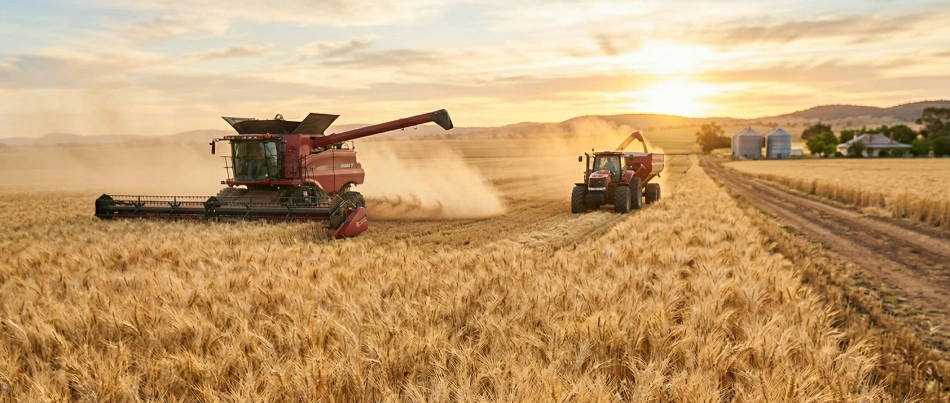
As we move into late March 2026, the Australian cropping landscape is a tale of two extremes. If you’re in Northern NSW or Queensland, you’re likely sitting on some of the best soil moisture profiles in years. But for the rest of the country, especially across Victoria, South Australia, and the WA grain belt, the situation is far more “standard Aussie”: dry.
With a potential El Niño event looming for late 2026, the strategy for this season isn’t about chasing the highest theoretical yield. It’s about resilience, risk management, and getting the basics right from day one.
The 2026 Starting Bucket
Before you hook up the air seeder, look at what’s actually in the soil.
- The South: Summer was exceptionally dry. While recent March showers provided some topsoil relief, sub-soil moisture is still low. Expect a “tight” finish, so choose varieties that can handle heat in October.
- The North: Summer cyclones left behind deep moisture. The challenge here won’t be germination; it will be managing high biomass and disease pressure if the wet continues.
- The Forecast: BOM indicates a transition to neutral conditions, but there’s a 70% chance of an El Niño developing by June/July. This means spring rain could be scarce. Plan for a dry finish.
Variety Selection: The Tough List
For 2026, the industry has shifted away from “high-input” varieties toward those that can “seek and find” water.
Wheat
- Shotgun: This is the big name for 2026. It’s effectively an upgraded Scepter. It has the same toughness but with a higher yield floor. If you have Scepter seed in the silo, it’s still a great bet, but Shotgun is the next gear for dry zones.
- Calibre: The “Moisture Seeker.” It has a significantly longer coleoptile (the shoot that pushes to the surface). If you’re dry-sowing at 6-8cm to hit moisture, Calibre is your safest choice to ensure the plant actually makes it out of the ground.
Barley
- Cyclops: In dry-finish trials over the last two years, Cyclops has consistently outperformed almost everything else. It’s quick, it’s tough, and it now has Malt accreditation.
- Neo CL: If you’re worried about weeds like brome or barley grass, Neo is the Clearfield (IMI) choice for 2026. It has great early vigor to choke out competitors early.
Canola
- Chronos TFI: A massive release for 2026. It carries both Triazine and IMI tolerances. In a year where herbicide carryover is a major risk (see below), this variety gives you the most flexibility.
The “Dry Summer” Trap
This is perhaps the biggest hidden risk for 2026. Because much of the south had a dry summer, the herbicides you used in 2025 (like Group 2 SUs or IMIs) haven’t broken down. They need moisture and warm soil for microbes to eat them.
Expert Tip: If you had less than 100mm of rain over the summer, assume there is chemical residue in the soil.
- Avoid sensitive pulses (like lentils) in paddocks with a “hot” chemical history.
- Consider switching to IMI-tolerant (CL) cereals to avoid “yellowing off” after the first big rain.
Agronomy: Simple Wins for 2026
Farmers don’t have time for complex theories. Here are three “non-negotiables” for the 2026 plant:
- Dry Sowing is Okay: Don’t wait for a perfect break. If the calendar says it’s time to sow, get it in. Waiting until June for rain reduces your yield potential by up to 30kg/ha for every day delayed.
- Inoculants: If you’re sowing pulses into dry dirt, use granular inoculant. Peat-based liquids will die in the dust before the rain hits. Granules stay alive longer.
- Fertiliser Safety: In dry soil, urea placed too close to the seed can burn the plant. Keep seed-placed Nitrogen low (under 10kg/ha) and put the rest down deep where it won’t hurt the seedling.
Market Pulse: Where’s the Money?
As of late March 2026, the markets are looking steady but lean.
- Wheat: Prices are holding around $330–$350/t for H2/APW.
- Barley: Feed barley is trading at a narrow discount to wheat (around $310/t). Because the premium for “Malt” is currently low, many growers are choosing high-yielding feed varieties and skipping the hassle of malt logistics.
- Canola: Sitting strong at $740/t (WA/SA ports). If you can get it established, it’s still the most profitable “break” crop on the map.
Your 2026 Pre-Sowing Checklist
- [ ] Check Subsoil: Push a probe in. How deep is the moisture?
- [ ] Check Chemical History: Did I use an SU or IMI last year? Has it rained enough to wash it out?
- [ ] Test Seed Germination: Don’t assume your saved seed is 100%. A simple wet paper towel test in the kitchen is all you need.
- [ ] Check Sowing Depth: If you’re chasing moisture, ensure your variety has the coleoptile length to handle it.