
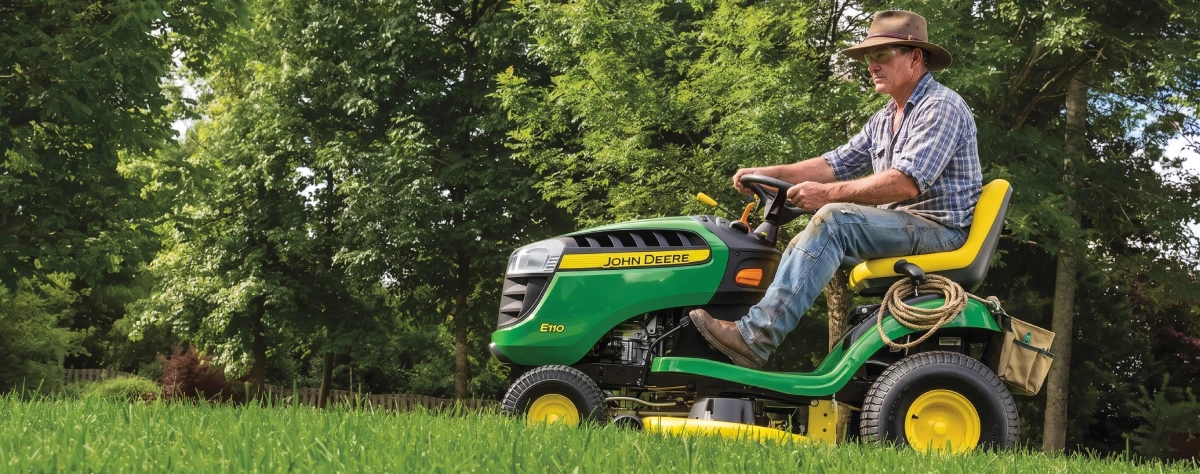
“Mower” covers a lot of ground on a rural property, from the ride-on that keeps the house yard tidy to the heavy slasher that knocks down a paddock of rank summer grass. They are not interchangeable, and buying the wrong one is an easy mistake to make. The trick is to start with the job, not the machine. Work out what you are actually cutting, how often, and how neat it needs to look, and the choice narrows quickly.
Here is how the main types stack up, and how to land on the right one for your place.
Almost everything you will look at falls into one of three camps: ride-on mowers for a tidy finish, slashers for paddocks and rough work, and flail mowers for heavy growth and mulching. Get clear on which camp you are in first.
A ride-on is for a neat cut on ground you want to look good: house yards, lifestyle blocks, orchards, verges and around sheds. It cuts low and tidy in a way a slasher never will. If your main job is keeping a few acres around the house looking sharp, this is your machine.
Within ride-ons, the big fork in the road is a conventional ride-on versus a zero-turn. A zero-turn spins on the spot, so it flies around trees, garden beds and obstacles and gets a big area done fast. The trade-off is that zero-turns can get skittish on steep or wet slopes, so if your ground is hilly, a conventional ride-on with good traction is often the safer buy. Think about deck width against your area too. A wider deck gets the job done quicker, but only if you have got the open ground to use it.
One thing worth spending on if you are cutting a real area: buy a machine built for the hours. A cheap domestic ride-on will do a small yard, but put a big lifestyle block through it every week and it will not last. A commercial-grade machine costs more up front and repays it.
The slasher is the workhorse of the paddock. Hung off the three-point linkage and driven by the PTO, it tops pasture, knocks down weeds, tidies fence lines and tracks, and handles long rank grass that would stop a ride-on dead. The finish is rough, but on pasture that does not matter. Toughness does.
Slashers come in a range of cut widths, and the right one is tied to your tractor, which we will get to. You will also choose between a standard linkage-mounted slasher and a trailed or offset model. A trailed slasher lets you cut a wider swath or run behind a smaller tractor, and an offset model swings out to the side, which is handy for reaching under fences and around trees. For most people a straightforward linkage-mounted slasher is the right call.
Pay attention to build. A heavy-duty deck with good steel will shrug off years of rough ground, while a light one will crack and fatigue. And look at the blades: many slashers run swinging or pivoting blades that give way when they hit a rock or a stump instead of stopping the machine dead. On rough, stony country, that feature saves gearboxes and tempers.
A flail mower cuts with a drum of small swinging flails rather than a big spinning blade, and it mulches what it cuts into fine bits. That makes it the pick for heavy, woody growth, and for anywhere you cannot afford to throw an object, because flails do not fling debris the way a slasher blade can. Around houses, along roadsides, in orchards and on verges, that safety matters.
The finish is tidier than a slasher and the mulch breaks down fast. The catch is that flail mowers cost more and ask for more horsepower to run. If your job is topping open paddocks, a slasher is the cheaper and simpler answer. If you are dealing with heavy trash, scrub regrowth or work near buildings and roads, the flail earns its keep.
This is where people come unstuck. A slasher that is too big for your tractor will bog it down, stall the PTO or simply refuse to do the job, and running one that is too heavy for the linkage is hard on the tractor.
As a rough guide, a five-foot slasher suits a smaller tractor in the thirty-five to forty-five horsepower range, a six-foot wants closer to fifty, and anything bigger climbs from there. Check a few things before you buy: the horsepower the slasher is rated for, whether it matches your three-point linkage category (Category 1 on smaller tractors, Category 2 on larger), and that your PTO speed lines up. If you are not sure, size the slasher a touch conservatively. A slightly smaller slasher your tractor runs comfortably beats a big one that labours.
Slashers are simple, tough gear, and a good used one is often the sensible buy. Ride-ons are a bit more mechanical, so condition matters more. Either way, look before you leap.
On a used slasher, work through this:
On a used ride-on, check the hours, watch how the engine starts and whether it smokes, look over the deck for rust and the spindles and belts for wear, and get a feel for the transmission, a hydrostatic drive should be smooth, not jerky or slow. Tyres and a level deck round it out.
If you are buying a tractor to run the slasher at the same time, ourused tractor checklist covers that side.
Slashers throw things. A blade spinning at PTO speed can fling a stone or a bit of wire a long way, so walk the paddock for debris before you start, keep people and stock well clear, and make sure the guarding and chains are in place. If you are working near a road, a house or anywhere people are about, a flail mower is the safer tool for the reason above.
You will see plenty of names on both sides. Slashers from the likes of Howard, Fieldquip, Agrifarm, Berends, Hustler, Jarrett and Waratah are common across Australian farms, and on the ride-on side John Deere, Kubota, Husqvarna, Cub Cadet, Toro and Iseki turn up regularly, with Hustler and Toro strong on zero-turns. They all build good gear. Buy for the job and the build quality rather than the badge.
On price, a slasher is one of the more affordable implements you can hang off a tractor, ride-ons span a wide range from domestic to commercial, and flail mowers sit at the dearer end. Prices move with condition and the market, so the real answer is to see what is selling. Browse the currentmower and slasher listings to get a proper feel for the money.
You can browsemowers and slashers for sale from sellers around the country, along with thetractors to run them. Every sale is protected through CheckVault escrow, so your money is held securely until the machine is in your yard and matches what was described.
Match the machine to the job, size a slasher to your tractor rather than your ambition, and buy something built for the hours you will put on it. Do that and you will spend your time cutting, not fixing.
Search our marketplace