
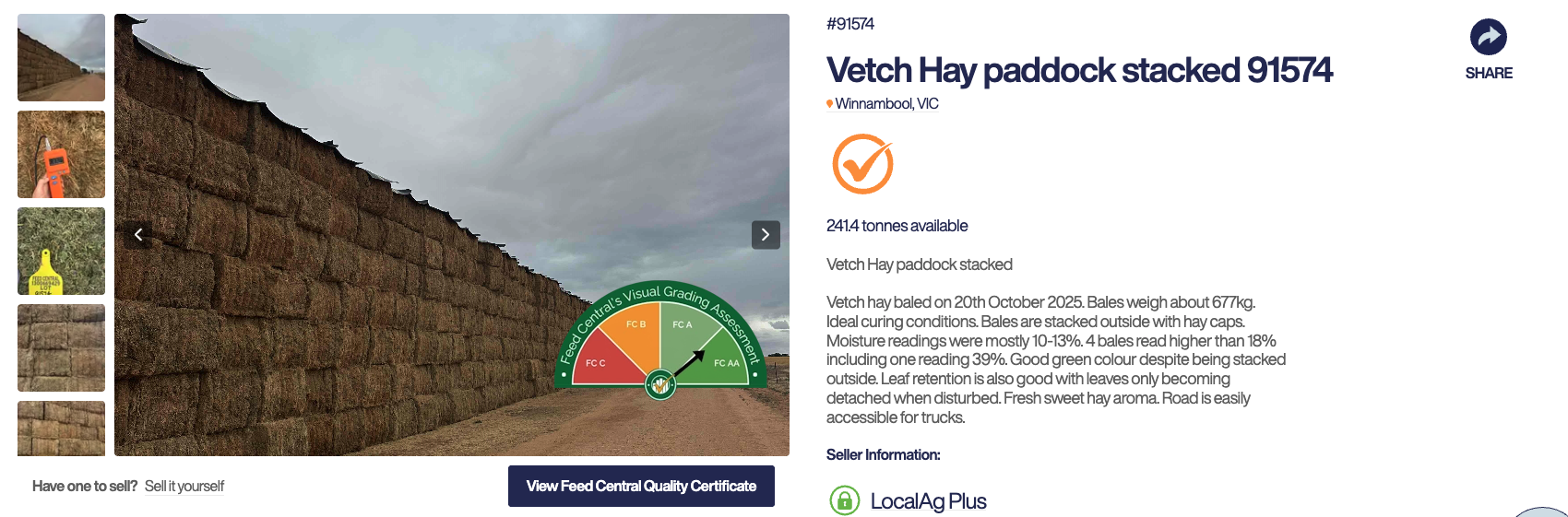
The fastest way to make your hay listing stand out is to show buyers the work behind the bale. Documenting your weed management, feed test results and paddock quality turns a generic listing into one a buyer can trust, and trust is what gives them the confidence to pay for quality. As one grower put it during a recent quality program rollout, not all hay is produced the same, and it is good to have a way of showing buyers the work that goes into it. The growers who communicate that work are the ones who get rewarded for it.
Most growers invest significant time, money and effort into weed control, crop management and biosecurity. The problem is that once hay is baled and stacked in the shed, there is often little to show for any of it. A bale looks like a bale. A listing that only states species and quantity leaves a buyer guessing, and a guessing buyer either pays a cautious price or buys from someone who told them more.
When a buyer cannot see the quality behind a listing, they price in the risk. They do not know how clean the paddock was, whether the hay was tested, or how it was stored, so they assume the worst and offer accordingly. Every piece of credible information you add removes a reason for them to discount.
This matters most for buyers with specific needs. A horse owner, a dairy operation or a feedlot is not just looking for hay. They are looking for hay that suits their animals, and they will favour a listing that gives them enough information to be sure.
You do not need to write an essay. You need to give buyers the few things that build confidence.
Include feed test results if you have them. A test removes guesswork on energy, protein and fast carbohydrate, and it is one of the strongest signals of quality you can offer. Buyers feeding sensitive animals often will not commit without one.
Describe your weed and biosecurity management. Buyers care about what is, and is not, in the hay. While no system guarantees weed-free hay, showing a genuine focus on weed management and biosecurity helps buyers identify hay produced with care.
Note how the hay was stored. Good shed storage protects quality, and saying so reassures a buyer that the hay has been looked after since baling.
Be specific about species, cut, quantity and location. Clear basics make a listing easy to act on and easy to find.
Use clear photos. A buyer who can see clean, well-presented bales is closer to making an offer.
Recognition for clean hay from well-managed paddocks is something growers have been asking for, and it starts with the listing itself. The hay is only half the sale. The other half is giving the buyer a reason to choose yours, and to pay a little more for the work that went into it.
A listing that only states species and quantity leaves buyers guessing, and guessing buyers discount. Documenting feed tests, weed and biosecurity management, storage and clear basics removes the reasons a buyer would pay less. This matters most for buyers with specific animal needs. Communicating quality is how you get rewarded for the work already done in the paddock.
Show buyers the quality behind your hay. Create a hay listing that stands out at localag.com.au.
Search our marketplace