
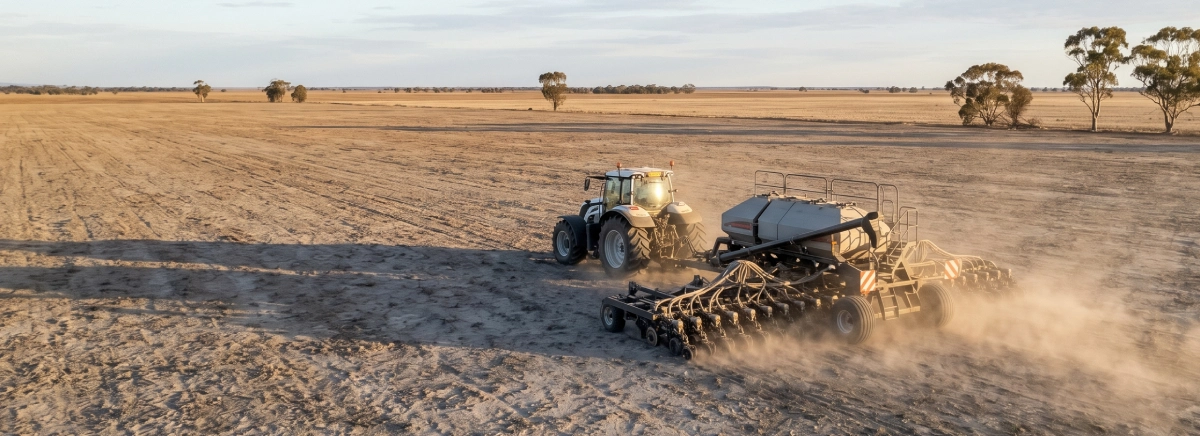
Dry sowing is not new. Australian grain growers have been doing it for decades, and it has become genuinely standard practice across WA, SA and much of Victoria. But in a year where subsoil moisture is short across most of the south-east and the winter outlook is below average, the decisions around dry sowing carry more weight than usual. Get the timing and depth right and you are ahead of the break, with more of your program in the ground before the season gets away from you. Get it wrong and you are re-sowing failed paddocks in June with a shrinking window and rising costs.
This is a practical guide to the key decisions: when to go, when to hold off, and how much moisture you actually need.
The core logic is simple. Every week you delay past your optimal sowing window costs you yield. GRDC research puts the penalty at roughly 7% per week once you have moved past the optimal window for your region. That number is not theoretical: it comes from real paddock data, and it explains why growers with large programs have always used dry sowing to stay ahead of the calendar.
In 2026, there is an additional reason. The BOM outlook for June to August gives a 60 to 80% chance of below-average rainfall across most of Victoria, SA, inland NSW and south-eastern Queensland. If you wait for a perfect moisture break, that break may not come until late May or June. By then, canola planted mid-June in many southern regions is running out of time to develop a strong enough canopy before spring. Cereals sown late are more exposed to heat stress during grain fill. The window shrinks, and so do your options.
Dry sowing does not guarantee a good result. But it gives you a chance. Waiting for perfect conditions in this season may mean you never get started.
This is the question growers ask most, and the honest answer is it depends on the crop.
Wheat and barley can germinate from relatively dry soil. They need the seed to imbibe around 35 to 45% of their own weight in water before germination begins, which can happen with surprisingly little surface moisture. In practice, wheat and barley can be sown into dry dust and germinate reliably off a 10 to 15mm rain event. They are the safest crops for true dry sowing with no moisture at seeding depth.
Canola is a different proposition. Its seed is tiny and carries very little energy reserve. BCG research found that canola emergence dropped sharply once soil moisture fell below around 8 to 10% volumetric water content, and there was essentially zero establishment in soil at 5% or below. In practical terms, canola needs either some residual moisture at sowing depth, or a rain event of at least 15 to 20mm within a week or two of sowing. It can be dry sown, but the risk of a patchy or failed stand is real on very dry country. If you have nothing in the profile and no rain in sight, that is a strong argument to either hold off on canola or reduce your canola area significantly.
Pulses sit somewhere between the two. Chickpeas and lentils can tolerate a dry sowing situation reasonably well on suitable soils, but faba beans are sensitive to dry establishment and are a poor candidate for moisture-free sowing.
There is a variation of dry sowing that experienced growers have always used and that deserves more discussion: putting seed into genuinely dry soil with no moisture-seeking intent, and simply waiting for rain to arrive. No chasing moisture at depth. No trying to find residual profile water. Just seed in the ground, sitting dormant, ready to go when the season breaks.
This approach makes particular sense when there is nothing useful in the profile at any depth, when the forecast window is unpredictable, or when your program is large enough that you need weeks of lead time before the break to get through it all. The seed sits, stays viable, and germinates when a meaningful rain event comes through.
The concept is sound, but there are two things that will undo it if you get them wrong.
The first is partial moisture. The danger zone is not completely dry soil, it is soil that is just damp enough to trigger imbibition but not wet enough to carry germination through to emergence. GRDC-funded research from WA found that moisture in apparently “dry” soil can trigger premature germination, resulting in seedling death before the plant ever reaches the surface. This is distinct from the false break problem. The seed has not fully germinated and then desiccated, it has started to absorb water and begun the germination process in soil that was never truly dry, then stalled and died underground. It is one of the harder losses to diagnose because it happens out of sight.
The practical implication: if your paddock has received recent rain, it may not be ready to dry sow in the “sow and sit” sense. DAFWA research established thresholds for what truly counts as dry. On sandy soils, anything more than 5mm of prior rainfall means the soil likely has enough residual moisture to cause problems. On loams the threshold is around 8mm, and on clay-textured soils around 10mm. If recent rain has exceeded these figures, the advice is to wait – up to two days in warm, dry conditions – for evaporation to bring the soil back to a genuinely dry state before sowing.
The second is depth. Sowing deep enough to keep seed below the zone where small moisture events reach is the key management lever for the sow-and-sit strategy. Light falls – the 5 to 8mm showers that are common in autumn – tend to wet only the top 2 to 3cm of soil. If your seed is sitting at 4 to 5cm or deeper, in genuinely dry soil below the wetting front, a light event will not reach it. The seed stays dormant. When a proper rain event of 15mm or more arrives, it wets through to seeding depth, and germination proceeds uniformly.
This is one reason the depth guidance for dry sowing matters beyond just the coleoptile discussion. Getting seed below the zone of partial wetting is protective. On sandier soils, where water moves faster and deeper, you may need to go a little deeper still to stay below the wetting front of a small event.
The limitation of this approach is canola. Canola cannot be sown deep enough to stay reliably below the partial-wetting zone without compromising emergence. At 30mm or less – the recommended maximum depth for canola – a 10 to 15mm rain event can reach the seed, trigger partial imbibition, and then leave it stranded if no follow-up moisture arrives. For cereals and some pulses, the sow-and-sit strategy is well proven. For canola on very dry paddocks with no subsoil moisture, the exposure to partial wetting events is a genuine risk and worth factoring into your paddock selection decisions.
When topsoil is dry and you are going into dust, depth placement is where a dry sowing either works or fails.
The instinct is to go deeper to find moisture. That can work, but only if your variety can get out of the ground from that depth. Wheat has a structure called a coleoptile that pushes the emerging shoot up through the soil. Most standard varieties have a coleoptile of around 5 to 6cm. If you sow at 7 or 8cm to reach moisture and your variety only has a 5cm coleoptile, the seedling leafs out underground. You lose the plant and get a thin stand. It is one of the more common causes of poor plant counts after dry sowing and it goes unnoticed because the failure happens below the surface.
If you are moisture-seeking at depth, use a variety with a longer coleoptile. Calibre is the main commercially available option with genuinely longer coleoptile genetics in an elite yield background. LRPB Lancer and LRPB Bale are also worth considering for situations where deep placement is necessary.
For canola, the recommended sowing depth for dry sowing is less than 30mm. Deeper placements dramatically reduce emergence rates. Unlike wheat, canola does not compensate for deep placement the same way, and pushing canola seed deeper in the hope of finding moisture is more likely to cost you a stand than save it.
As a general guide for dry sowing situations:
This is what keeps growers up at night during dry sowing season. You have your program in the ground. A 10mm rain event comes through. Seeds start to imbibe water, germination begins, the radical emerges. Then it stays dry for another three weeks. The germinating seed desiccates in the topsoil and dies.
The good news is that research and accumulated grower experience suggests this risk is smaller than it used to be feared. Studies in WA found that dry-sown crops exposed to small opening events generally fared better than expected, and that the yield advantage of earlier sowing usually outweighed the occasional failed germination from a false break. Canola recovery from a false break is harder than cereals, because a failed stand is harder to patch and the crop has less time to re-establish.
The practical management tool is seeding rate. In dry conditions, bump your seeding rate up around 10% on cereals. Germination rates are lower in dry soil, mice take more seed pre-germination, and the insurance cost is low. With canola, if you are going in dry on a paddock with limited subsoil moisture, concentrating on your better soils and holding the more marginal area back is a smarter hedge than trying to cover everything and having widespread thin stands.
There are situations where dry sowing is the wrong call.
Northern NSW and southern Queensland are the clearest example this season. Many areas in these regions have very low to severely deficient subsoil moisture after months of below-average rainfall. NSW recorded its second driest April on record in 2026. Sowing winter crops into a profile with nothing in reserve and a below-average winter outlook ahead is a high-risk proposition. For growers in these zones, the calculus is different to the south. The question is not just about getting establishment; it is about whether the crop has enough stored moisture to reach grain fill. In many parts of northern NSW and southern QLD this season, the honest answer is probably not, and growers are better served redirecting that capital and cash flow elsewhere.
Canola on very light sandy country with no subsoil moisture and no rain forecast is another case where dry sowing does not make sense. The establishment risk is too high on low water-holding soils when there is nothing in the profile to draw on.
Any paddock with Group 2 herbicide carryover from a dry 2025 deserves careful thought before planting sensitive crops. Sulfonylureas and imidazolinones break down slowly in dry soil with low organic matter. A canola crop on a paddock where SU herbicides were applied in 2025 and summer rain was minimal is a real risk. Switch to IMI-tolerant (Clearfield) canola on those paddocks or hold them for a cereal.
Last year’s crop is the most useful reference point going into 2026. Across much of southern Australia, dry sowing in 2025 worked. Crops went in on dust, waited for rain, emerged when it came, and eventually finished above expectations. That result is encouraging.
But the 2025 season also benefited from July rainfall that allowed dry-sown crops to emerge and establish, and from October rain that carried crops through grain fill. The BOM’s current outlook suggests 2026 may not hand out those same lifelines. Planning as if the July and October events will repeat is optimistic. The smarter approach is to get your program in the ground early enough that a modest opening break works in your favour, rather than banking on a season-saving rain in October to rescue a late-sown crop.
Get the right crop in the right paddock. Use varieties suited to moisture-seeking if you are going deep. Watch your depth carefully. If you are sowing into truly dry soil and waiting for rain, make sure the soil is genuinely dry before you go, not just recently rained on. And if you are in the northern zones where the subsoil is genuinely empty, be honest about whether that capital is better spent elsewhere this season.
Sources: GRDC Time of Sowing factsheet; Birchip Cropping Group canola establishment research; Riverine Plains dry sowing risk management guide; ABARES Weekly Update May 2026; Bureau of Meteorology JJA 2026 Long-Range Forecast; DAFWA/GRDC dry sowing canola research, Merredin and Kellerberrin trials.
Search our marketplace