
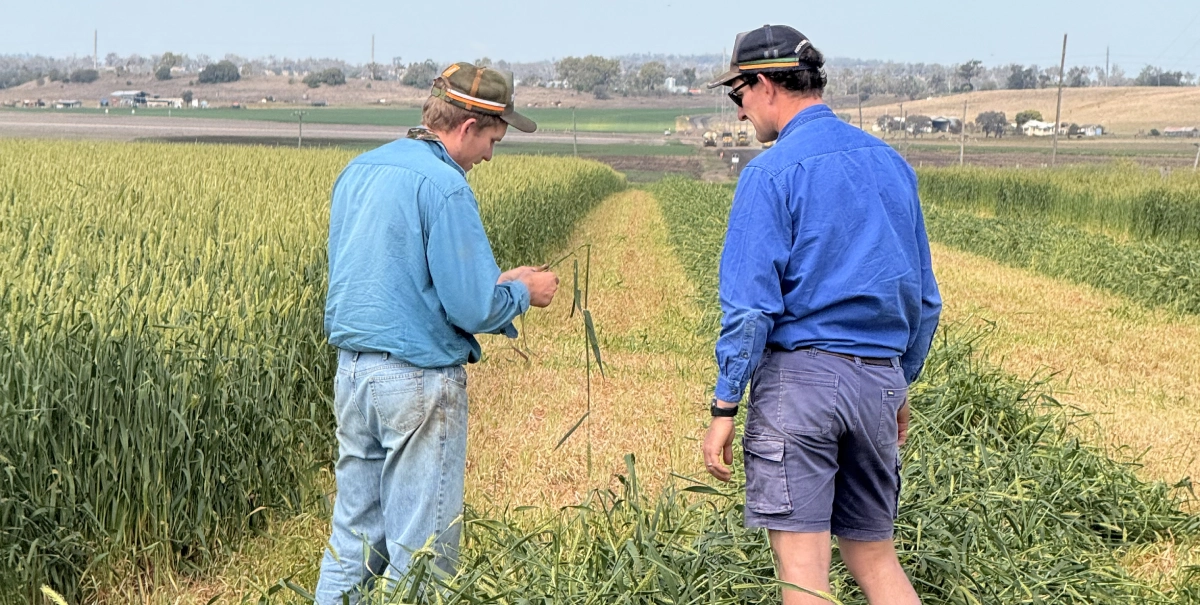
Variety selection in a normal year is mostly about yield potential and disease resistance. In a year like 2026, it is about something more fundamental: whether the plant can get out of the ground at all, and whether it can finish before the moisture runs out.
Across most of southern and eastern Australia, subsoil moisture going into this winter is below average to severely deficient. The Bureau of Meteorology’s June to August outlook gives a 60 to 80% probability of below-average rainfall across most of Victoria, SA, inland NSW and south-eastern Queensland. Models are pointing toward El Niño development during winter. This is not a season for chasing theoretical yield ceilings. It is a season for choosing varieties that can establish in difficult conditions, tolerate a lean profile, and finish reliably under terminal moisture stress.
Here is a practical breakdown by crop type.
Wheat is the most forgiving of the major winter crops in a dry start, but variety choice still matters considerably when you are sowing into marginal topsoil or moisture-seeking at depth.
Coleoptile length is the first thing to check. When topsoil is dry and you are placing seed at 6 to 8cm to hit moisture, the coleoptile, the protective sheath that pushes the emerging shoot up through the soil, has to be long enough to reach the surface. Most standard varieties max out around 5 to 6cm. If you sow at 7cm with a variety that has a 5cm coleoptile, the seedling leafs out underground and dies. You never see it fail: you just get a poor plant count two weeks later and wonder what went wrong.
Calibre, bred by AGT from Scepter genetics, is the standout variety for deep or moisture-seeking situations. It carries significantly longer coleoptile genetics than its parent and has widely outperformed Scepter in SA, VIC and southern NSW trials. It retains AH quality classification across those regions and offers improved stripe rust and powdery mildew resistance over Scepter. If you are sowing into dry or receding moisture profiles this season, Calibre deserves serious consideration over standard-coleoptile varieties.
LRPB Lancer and LRPB Bale also carry long coleoptile genetics and have been used specifically for moisture-seeking sowing, particularly in the Victorian Mallee and WA. CSIRO research has shown an average yield benefit of 18 to 20% from deep sowing with long-coleoptile varieties compared to conventional placement, purely from improved establishment.
For late sowing windows, Vixen remains the standout. If the break does not arrive until late May or early June, you need a variety that can race through its life cycle and grain-fill before October heat arrives. Vixen’s quick maturity makes it the variety most growers reach for when they have missed the optimal sowing window. It is not a variety for early April sowing on good moisture, but for late breaks in southern NSW and Victoria it has consistently performed well.
Rockstar has built a strong reputation across Victoria and southern NSW over the past few seasons, particularly in environments with variable and below-average growing season rainfall. It suits mid-season sowing and carries a good disease resistance package.
For WA growers, the standard advice around Scepter still broadly holds for average to good moisture situations, but Calibre’s availability as a direct replacement with improved coleoptile length and marginally better yields makes it the obvious step up for the 2026 season on drier country.
On seeding rates. In dry soil, germination is rarely close to 100%. Between seed rotting in semi-moist soil before rain arrives and mice predation on dry-sown paddocks, losses between the bag and the plant are higher than normal. Increasing your target seeding rate by around 10% compared to a normal season is a reasonable buffer to ensure you hit adequate plant populations.
Canola is the most sensitive major crop to a dry start. It has a small seed, limited energy reserves, and needs reliable moisture at the soil surface to establish. In 2026, the canola decision is less about which variety and more about whether canola belongs in your program at all given your paddock’s soil moisture status.
That said, variety choice genuinely changes the risk profile when you do decide to proceed.
Hybrids versus open pollinated in a dry year. This is more nuanced than it is often presented. Research published in Crop and Pasture Science found that hybrid canola out-yielded open-pollinated (OP) varieties in medium to high rainfall environments, but in low rainfall areas where yield potential was below around 0.7 t/ha, hybrids showed little consistent advantage over OP varieties. The break-even yield for a hybrid to justify its seed cost premium over OP is roughly 1.25 t/ha for TT and around 1.7 t/ha for hybrid CL types.
However, there is a separate argument for hybrids in dry conditions that has nothing to do with yield: larger seed size. Hybrid canola seed is consistently heavier and larger than OP, and this matters when you are sowing deep or into marginal moisture. Larger seeds carry more energy reserves, produce more vigorous seedlings, and maintain higher emergence rates from greater depth. Research comparing hybrid and OP canola at depths greater than 30mm found hybrids maintained higher emergence rates specifically because of seed size, not genetics per se. If you can source OP varieties with larger seed lots you get some of that benefit at lower cost, but hybrid seed size advantage is generally reliable.
For 2026, if you are proceeding with canola on lower-rainfall or marginal-moisture country, a hybrid with early vigour characteristics is the sensible choice. Pioneer PY432T is rated for low to medium rainfall environments and has mid to fast phenology. Nuseed’s Vesta IMI suits similar environments and carries IMI (Clearfield) tolerance, which is worth noting this season given herbicide carryover risks from the dry 2025.
On herbicide carryover. The dry 2025 summer means sulfonylurea and imidazolinone herbicides have not broken down in many paddocks as they normally would. Canola is highly sensitive to imidazolinone carryover. If a paddock received IMI chemistry in 2025 and has had less than 100mm of summer rain, either avoid canola there or use an IMI-tolerant (Clearfield) variety. It is a simple risk management decision that can save a canola establishment from scratch.
Seed rate with canola is critical. The target plant population for canola is typically 40 to 60 plants per square metre. In dry conditions, achieving that from a standard seeding rate is unlikely. Canola is also not a crop that compensates well for thin plant populations the way wheat does. On marginal moisture country, it is better to concentrate your canola on your best-moisture paddocks and achieve full plant counts there than to spread it thin across more area and struggle everywhere.
Barley is generally more tolerant of a dry start than wheat and considerably more so than canola. It germinates at lower soil temperatures, establishes quickly, and can tolerate a degree of osmotic stress at germination better than most cereals. In a difficult year, shifting area from wheat into barley on your drier paddocks is a reasonable strategy.
The malt premium question is less relevant this season than it normally would be. With malt premiums soft heading into 2026–27 harvest and a season that is shaping up to favour feed-grain demand, many growers are rightly deprioritising malt quality in variety selection and focusing on agronomic performance.
Spartacus CL offers the benefits of Clearfield herbicide tolerance alongside solid dry-season yield performance in southern Australia. It is a useful option where ryegrass or brome grass pressure is high, and the IMI tolerance provides a safety net on paddocks with potential Group 2 herbicide carryover from 2025.
RGT Planet and Laperouse have both shown strong performance in low-rainfall NVT environments across SA and VIC. For WA growers, the newer varieties out of DPIRD’s 2026 Sowing Guide are worth reviewing, with several feed barley releases specifically targeted at WA’s drier northern zones.
Where you want sheer volume and toughness on marginal country, Combat remains a reliable choice, particularly in feed barley situations where premium classification is not the priority.
The pulse decision in 2026 requires more caution than cereals. Most pulses are less drought-tolerant at establishment than wheat or barley, and the consequences of a failed pulse establishment are harder to recover from. With that said, chickpeas and lentils offer genuine advantages in the right situation.
Chickpea is widely considered the most drought-tolerant cool-season pulse in Australian conditions. Its deep taproot, once established, gives it access to subsoil moisture that shallower-rooted crops cannot reach. On well-drained, neutral to alkaline soils in medium-rainfall zones of QLD, NSW and SA, chickpea remains a strong break crop candidate even in a dry year, provided you can get establishment. The critical issue is getting seed into moist soil at the right depth. Chickpeas need at least 20mm of soil moisture at sowing depth for reliable germination.
Lentils have become the dominant grain legume in Victoria and SA partly because of their drought tolerance and marketability. They are a reasonable inclusion on better-moisture paddocks in those states, but their shallow root system makes them vulnerable to late-season dry finishes, which the 2026 JJA outlook suggests is a real risk.
Faba beans are a different story. They are particularly sensitive to dry conditions and poorly suited to a moisture-deficient establishment. Unless you have reliable topsoil moisture at sowing time, faba beans carry significant risk this season.
Inoculant selection matters especially in dry conditions. This is a detail that costs very little to get right but can quietly destroy a pulse crop if it goes wrong. Do not use peat-based liquid inoculants when dry sowing. The rhizobacteria in peat slurry die within hours in dry soil. They need moisture to survive long enough to establish on the roots. On dry or moisture-seeking sowings, use granular inoculants applied in the seed row. Products like TagTeam granular are far more resilient to heat and dry soil conditions and will remain viable in dust until rain arrives. It is a simple switch that makes a significant difference to nodulation and nitrogen fixation outcomes.
In most years, the variety question centres on yield and disease. This year it starts one step back: can this variety establish from the depth I need to sow at, in the moisture conditions I actually have?
From there, the question becomes whether the variety can carry through to grain-fill on a profile that is unlikely to be recharged by in-season rain. Varieties with solid performance under terminal drought conditions, mid-range maturity that avoids the worst of spring heat, and a disease package that doesn’t require wet conditions to deliver are the ones that will earn their keep in 2026.
Check your state’s current NVT data before finalising selections. Variety performance is regional, and what performs well in one cropping district can underperform significantly in another. The 2026 crop sowing guides for WA, VIC/TAS, NSW and SA are all available from GRDC and the relevant state departments, and they are worth your time before you pull the trigger on seed orders.
Sources: CSIRO Long Coleoptile Wheat Research Program; AGT Calibre variety release notes; GRDC Birchip Cropping Group deep sowing trials; Crop and Pasture Science: Relative yield and profit of hybrid vs OP canola (Zhang et al.); NSW DPIRD Canola and Pulse Variety Update Spring 2025; GRDC Inoculating Legumes Back Pocket Guide; Bureau of Meteorology JJA 2026 Long-Range Forecast.