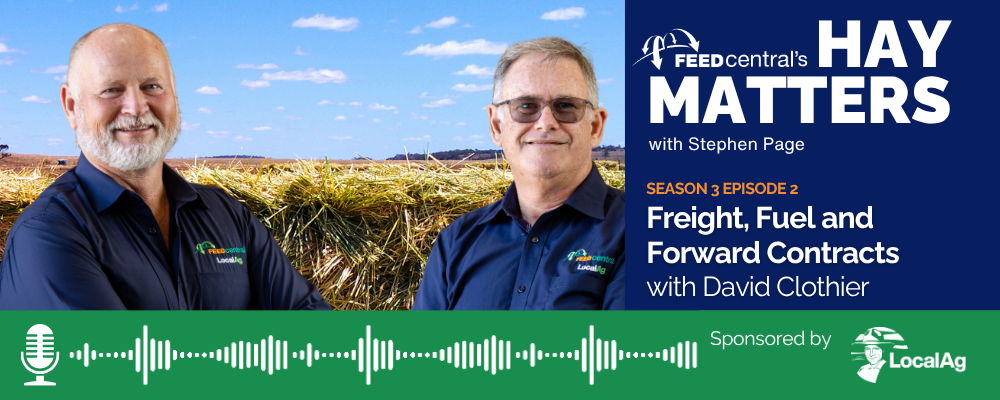
Hay Matters Podcast
Tim Ford 00:02
Hi, I’m Tim Ford. Welcome to the hay matters podcast, where the feed central and local ag team unpack the very best of what’s happening in Australia’s fodder industry, from planting through to baling, testing and feeding, we cover the characters and the information that matters most to everyone in the supply chain. Hello.
Steve Page 00:24
Hi, it’s Steve Page here from Feed Central and LocalAg with another podcast.
It’s the end of March, heading quickly into April, and I’ve got our National Sales Manager, Dave Clothier, with me.
Good morning, Dave.
Dave Clothier 00:52
Morning, Steve. Great to see you, mate.
We’ve both done a few long trips in the last month or so, caught up with growers and buyers. How did it go for you?
Steve Page 01:01
Yeah, plenty happening out there. What about your trip?
Dave Clothier 01:06
It reminded me I need to get out there more often.
I spent two weeks starting in Adelaide, across southern South Australia, into Victoria, and right across northern Victoria. A lot happened while I was away.
There was a major weather event in northern Victoria just before I arrived, and then the fuel shortage became a big talking point. So plenty changed in a short time.
Steve Page 01:29
It’s been a pretty interesting couple of weeks.
You would have seen rain through Victoria, the Wimmera, Mallee and parts of South Australia?
Dave Clothier 01:39
Yeah, and it surprised me.
The media made it sound like everything was underwater. But in reality, a lot of areas only had 10 to 50 mm early on, increasing further north.
Then across northern Victoria, it ranged from about 70 mm to 180 mm. What amazed me most was how quickly the country soaked it up. There wasn’t much water lying around at all.
Steve Page 02:49
And now along that Vic–NSW border, they’ve got a full moisture profile and confidence heading into planting.
There’s been some fertiliser going out and some early oats for grazing, but planting for grain and hay is still a couple of weeks away.
Irrigation water is still tight though, so that could become an issue later in the season.
There’s also some talk of El Niño still hanging around.
Dave Clothier 03:53
It was an interesting time to be down there.
That rain event stopped demand moving south of where it fell, which created concern for growers sitting on sheds full of hay and straw.
That’s led to more conversations around forward contracts and securing demand further north.
Growers are looking to move volume, free up shed space for the new season, and reduce risk.
But we’re only just into autumn. We’re still a couple of months away from winter, the traditional selling period, so there’s no need to panic.
Dave Clothier (continued)
There is still a lot of hay in the system, mostly concentrated around the NSW–Victoria border and into South Australia.
Export demand on better quality lines remains strong, which is helping move product.
At the same time, global uncertainty, fuel concerns and input costs are all influencing planting decisions.
Steve Page 06:38
We’re seeing roughly 130,000 tonnes of cereal hay in the system.
A lot of the top-quality lines are already moving, but there’s still good hay available.
Freight is becoming the big issue though, especially getting hay into drier areas further north.
Lucerne is tighter, with around 20,000 tonnes currently advertised.
Dave Clothier 07:56
Freight is the key challenge right now.
In many cases, the freight is costing more than the hay itself.
So growers closer to demand centres are seeing strong prices, while those further away are struggling to compete.
If cash flow is needed, growers should review their ex-farm pricing and consider their options.
Steve Page 09:32
Looking ahead, we expect a lot of empty sheds by the end of winter.
There’s opportunity in the next season, especially if inputs like urea are tight.
We’re already seeing interest in vetch hay as an alternative, particularly with protein hay likely to be in short supply.
Dave Clothier 10:17
I heard the same thing.
Some growers are already planting vetch, and others are seriously considering it. There’s clearly an opportunity there.
Steve Page 10:44
Flexibility will be key this season.
With El Niño still a possibility, growers need to be able to switch between grain and hay depending on how the season plays out.
Shed capacity will be critical to capitalise on those opportunities.
Dave Clothier 11:25
One thing that stood out to me was how professional and well set up many growers are across southern Australia.
There’s a lot of investment going into infrastructure, particularly sheds, which is a strong sign of confidence in the industry.
Across livestock, beef and sheep sectors, things remain strong overall.
Dave Clothier (continued)
Feedlot numbers are at record levels, around 1.6 million head, with capacity still growing.
That underpins strong demand for fodder.
Supply is shifting further south, which creates opportunity for those growers, particularly with northern demand remaining strong.
Steve Page 16:33
There’s still a big dry stretch between southern supply and northern demand.
New South Wales is particularly dry, so a seasonal break is needed.
We’re still early though, so there’s time.
Dave Clothier 17:41
The key message is to stay alert.
Things can change quickly, and growers should seek advice and stay informed.
There’s a lot happening globally, but locally, we’re in a strong position as an exporting country with solid livestock demand.
Steve Page 18:32
We’ve got a long winter ahead.
Make the most of opportunities as they come, and set yourself up to take advantage of them.
Dave Clothier 18:49
There’s been steady business right through what is usually a quiet period.
We’re still two months away from peak selling, which is a positive sign.
Tim Ford 19:42
Thanks for joining us.
Don’t forget to follow the show on your podcast app, leave a review, and share the episode.
This podcast is hosted by Steve Page, presented by Feed Central and sponsored by LocalAg Marketplace.
Producer: Cara Stewart
Audio Editor: Ellen Ronalds Keen
Music: Pianio You